I spent eight months posting before I made my first dollar online. I’m not talking about eight months of half-assed posts. That account was my little baby. I was building something I was proud of. Started getting some followers. And that was awesome. But what I wasn’t getting was dollars.
The problem wasn’t the content. The problem was I had confused building an audience with building a business. Those are two different things and most people online never figure that out until they’ve already lost a year to it.
Everyone Who Sold You On “Build Your Audience First” Already Had One
You’ve heard it a thousand times. Post consistently. Provide value. Grow your following. Then the money follows.
The people saying it aren’t lying. It works. But there’s a part of the story they’re leaving out and it’s the part that matters most when you’re starting from zero.
The creator telling you to build your audience first already had fifty thousand followers when they started teaching that strategy. The coach selling the grow first monetize later framework already had three years of compounding content before they launched the thing that actually made them real money. The advice isn’t wrong. It just comes with a timeline nobody says out loud. Eighteen to thirty six months minimum before audience dependent income is real. And that’s with the algorithm cooperating, which it increasingly doesn’t.
Most people can’t wait that long. Most people don’t need to.
I hit a wall around month six. Still making essentially nothing. So I sat down one night and actually ran the numbers forward instead of just watching my follower count go up and feeling good about it. At a one percent email list conversion rate and a two percent purchase rate on a ninety seven dollar product, you need roughly fifty thousand followers to generate a thousand dollars from a single promotion. For most people posting consistently that is a year to two years of work stacked on top of each other before a single dollar comes out the other end.
A funnel with five hundred targeted visitors, a free lead magnet, a thirty percent opt in rate, and a three percent purchase rate on a ninety seven dollar backend offer generates roughly four hundred and forty dollars from a single traffic push. Not a thousand dollars. But it does it in a week. With no followers. No waiting. With a system you actually own.
That math changed everything for me.

The Night It Actually Clicked
I remember exactly where I was when it landed. Sitting at my kitchen table at about eleven at night, still in work clothes. I had a spreadsheet open on one tab and my latest post analytics open on another. The post had done well. Two thousand impressions. Solid engagement. A handful of new followers. Six months in and I was genuinely proud of what I was building.
Then I did something I had never actually done before. I ran the numbers forward.
I took my current follower count, applied a realistic email conversion rate, applied a realistic purchase rate, and looked at what that actually produced in dollars. Then I looked at how long it would take me to reach the follower count where those numbers made real money.
I had to run it twice because I didn’t believe the first result.
At the rate I was going I was eighteen months away from making a thousand dollars from a single promotion. Eighteen months. With everything going right. With the algorithm cooperating. With me showing up every single day.
I wasn’t angry about it. I was just suddenly very clear on the fact that I had been optimizing for the wrong thing the entire time. The follower count was a vanity metric dressed up as a strategy. I closed the analytics tab and opened a new one. I started looking at funnels.
Here’s What I Actually Built
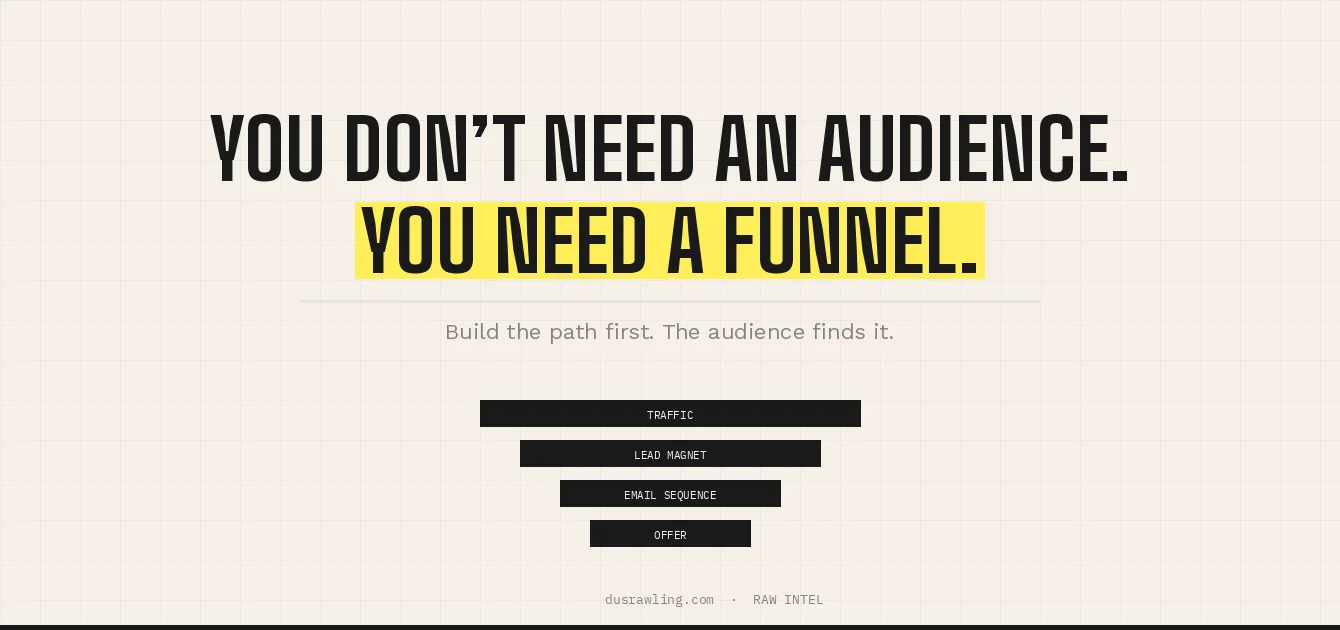
A funnel isn’t a tech stack. It’s not a complicated diagram with arrows pointing everywhere. It’s a defined path from cold stranger to paying customer. The key word is defined. You make the decisions once. The system runs them after that.
Mine had four pieces.
A traffic source. I picked one and stayed there. Organic SEO on a topic I already knew cold. One piece of content, one search query, built to rank. Took six weeks to start pulling traffic. I’ve watched people do the same thing faster with five to ten dollars a day in Meta ads. Either way works. Picking one and not bouncing between three is the part that matters.
A lead magnet. One page. One specific free resource that solved one painful problem for one specific kind of person. Not a generic ebook. One tool. Hosted on Carrd for nineteen dollars a year. Opt in rate on targeted traffic was twenty eight percent.
An email sequence. Seven emails. Fourteen days. Written once. Loaded into ConvertKit which costs twenty nine dollars a month until you hit a thousand subscribers. Each email built on the last one. The last three made an offer. Not aggressively. Just clearly. Here is what I have. Here is what it does. Here is where you go if you want it.
An offer. Ninety seven dollars. Delivered automatically through Gumroad which takes ten percent and handles everything on the delivery side. No checkout page to build. No payment processor to configure. Nothing to manage manually.

Total monthly cost to run the whole thing was forty eight dollars. First month it made money it did three hundred and seventy dollars. Second month six hundred and forty. Not because I had more followers. Because the sequence got tighter and the traffic got more consistent.
I had not posted a single piece of social content the entire time.
The Audience Did Come. It Just Wasn’t The Foundation.
I am not saying don’t build an audience. I am saying don’t make building an audience the prerequisite for making money. That is the version of the advice that keeps people stuck.
Once the funnel was generating consistent income I started building content. But the relationship had completely flipped. I wasn’t posting and hoping something would eventually monetize. I was posting to put more people at the top of something that already worked. The audience became a traffic multiplier, not the business itself. That is a completely different thing to be building toward.
The person waiting for ten thousand followers before they launch anything is running a fundamentally different operation than the person with six hundred followers and a funnel that converts. One of them is dependent on an algorithm they don’t control, a platform that can change its rules overnight, and a timeline that requires patience most people run out of. The other one has a business that makes money today.
A 2026 survey of a thousand creators found that forty eight point seven percent still earn under ten thousand dollars a year. Most of them had audiences. What they didn’t have was a defined path from that audience to a sale.
The funnel is that path. It doesn’t require anyone to follow you. It doesn’t require virality or consistency or an algorithm that cooperates. It requires that you make a set of decisions once about who this is for, what they need, what you’re offering, and how they get there. Then you let the system run those decisions.
That is the boring part. That is also the part that actually works.
The audience building advice isn’t bad advice. It’s advice for a different stage than where most people actually are. You don’t need fifty thousand followers to make money online. You need five hundred people who were already looking for what you built.
Build the path first. The audience finds it.